




2024
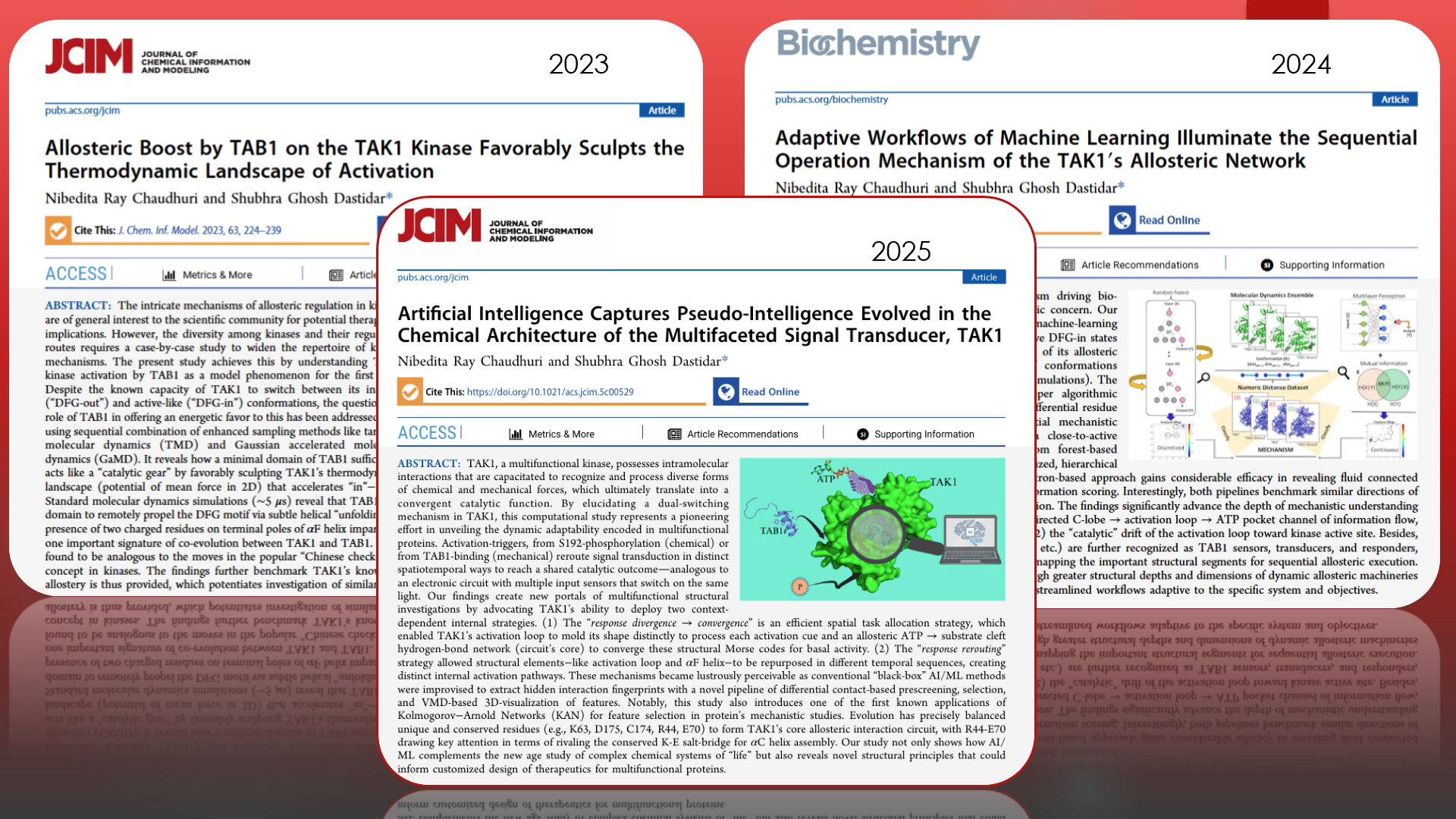
Adaptive Workflows of Machine Learning Illuminate the Sequential Operation Mechanism of TAK1's Allosteric Network
Biochemistry

PhD: University of Calcutta, 2006
Biomolecules and their assemblies are complex chemical systems. Understanding their mechanisms of functions require various methods of investigations, in truly interdisciplinary mode, covering theoretical, experimental, computational methods and even data analytics. In our group we address those questions on the mechanism of functions Biomolecular systems, which would require insights not only from the molecular structures but also would need the information on the dynamics of the constituent atoms; in fact in real systems the atoms and molecules in a cell are always jiggling, dancing and bumping into each other at any given temperature. For example, one may figure out a model structure of a protein from the experimental measurement or may obtain from from a structure database, but that may not be sufficient to guess the mechanical flexibility of the system which could have relation with the function. The dynamics could be simulated in computer using fundamental principles of Chemistry, Biochemistry, Physics and the obtained datasets are analyzed using statistical methods to interpret the observations in Life sciences. The computations are done on large scale parallel computing platforms, often using GP-GPU based machines.
Our systems of specific interests are proteins, lipids, nucleic acids, small molecule (drugs). These exercises only tells us how do the biomolecules function but also lead to understand the kind of errors at the molecular level that can result functional defect and diseases. Once this is understood, it provides a direction for designing a lead compound (drug molecule) in a rational manner. Some of our recent interests include (i) mechanism of conformational modulations on αβ-Tubulin dimer and their control over cell divisions, (ii) structural dynamics of the Bcl2 family of proteins and their role in apoptosis and cancer therapy, (iii) Kinase allosteric and their inhibition using drug molecules, (iv) ligand design and various others.
Primarily we use standard molecular dynamics methods to simulate the all-atom dynamics of the systems and also use more advanced methods of accelerated molecular dynamics to compute the free energy landscapes of the biomolecular functions. We are also developing machine learning based protocols to analyze conformational ensembles.
Our research combines molecular dynamics simulations, enhanced sampling techniques, thermodynamic analysis, and machine learning to investigate protein conformational landscapes, ligand binding, and allosteric regulation.
Our recent work on TAK1 kinase comprises a trilogy of studies investigating its structural dynamics, allosteric regulation, and activation mechanisms. These studies provide insights into the molecular basis of kinase regulation and the role of conformational changes in modulating its activity.
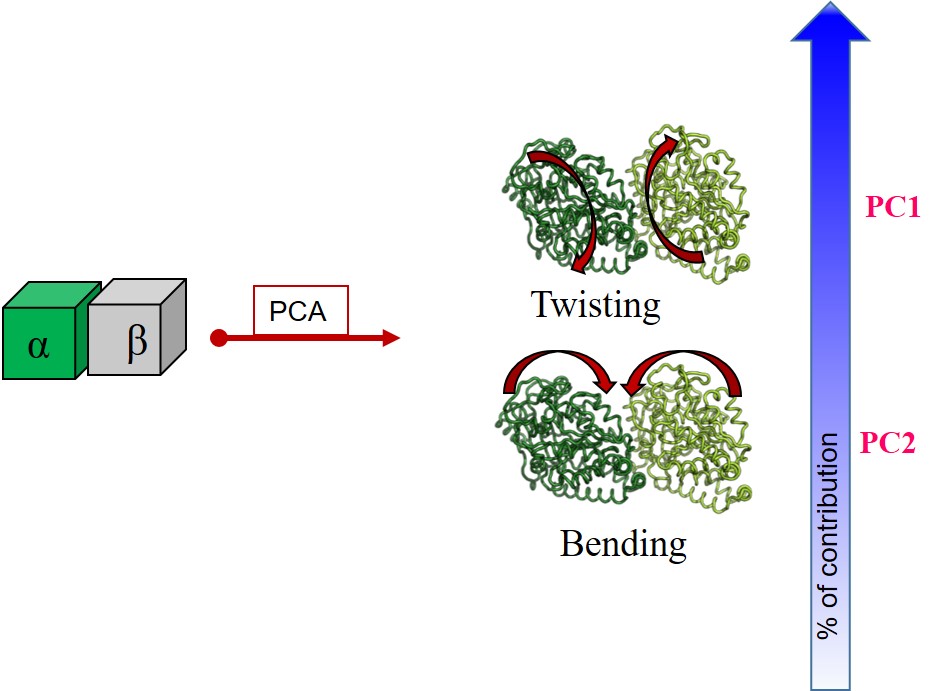
Our investigations revealed that ligand-induced changes in the ability of the α,β-tubulin dimer to form microtubules and spindles arise from the switching between principal modes of internal motion.
These findings demonstrate how ligand binding reshapes the accessible conformational space of tubulin and modulates its internal dynamics.
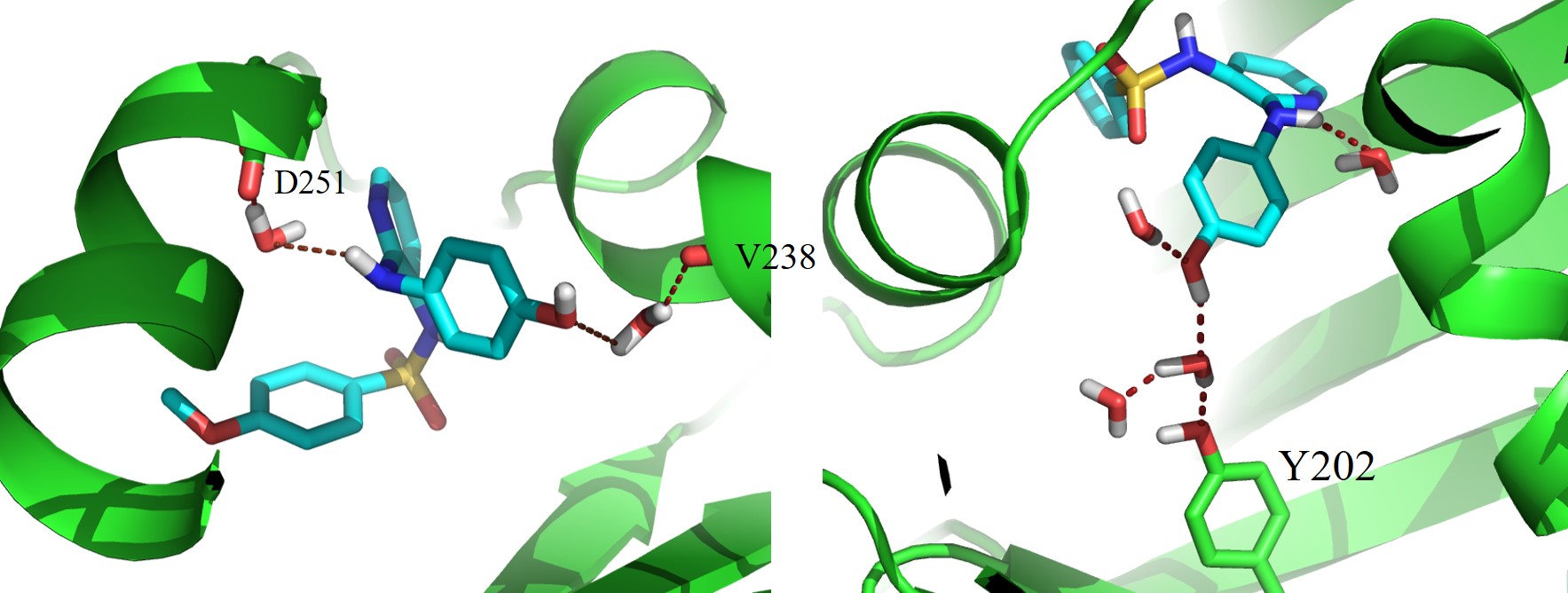
Microclusters of water molecules play a crucial role in determining protein–ligand binding affinities. Using the α,β-tubulin dimer and its complex with E7010, we demonstrated the importance of incorporating these water molecules into binding free-energy calculations.
The study highlights how structured water molecules complement ligand conformational states and contribute to molecular recognition within the protein core.
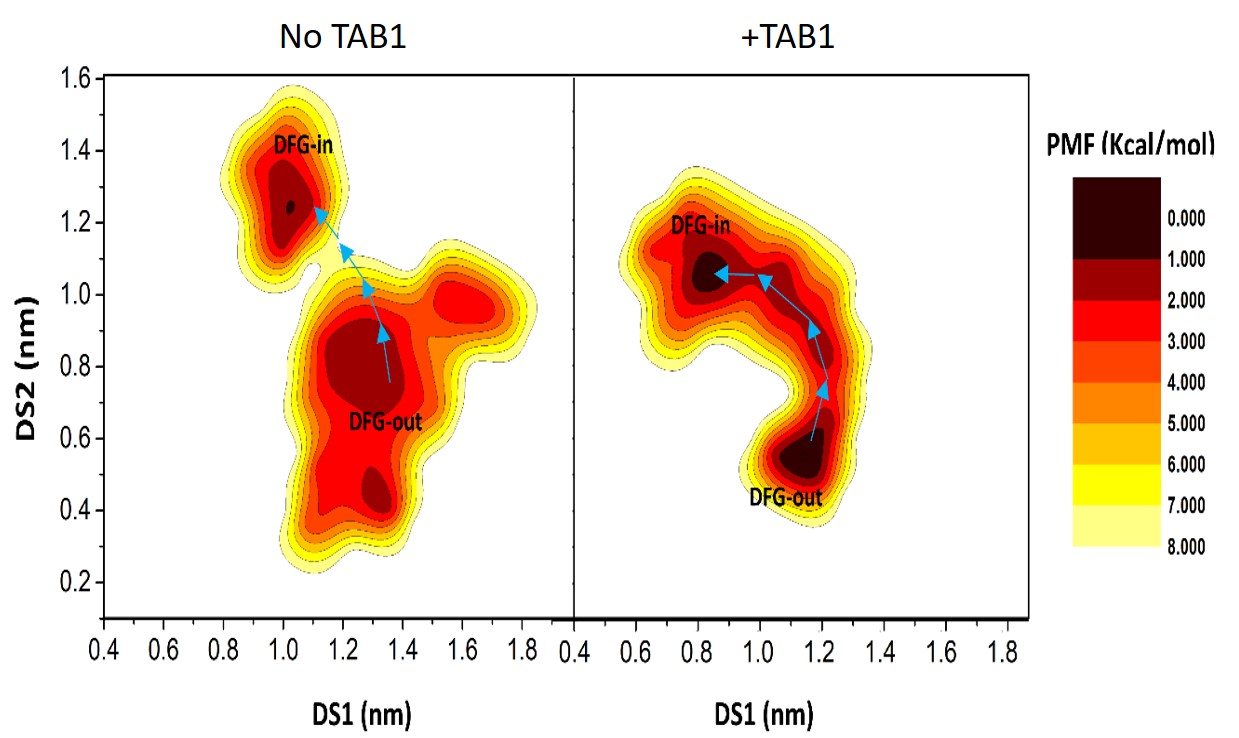
We investigated the influence of the allosteric activator TAB1 on the activation landscape of TAK1 kinase. The two-dimensional potential of mean force (PMF) landscapes reveal how TAB1 reshapes the thermodynamic pathways associated with kinase activation.
The study employed 5 microseconds of conventional molecular dynamics simulations, alongside targeted molecular dynamics (TMD) and Gaussian accelerated molecular dynamics (GaMD), to explore the conformational and thermodynamic landscape of activation.
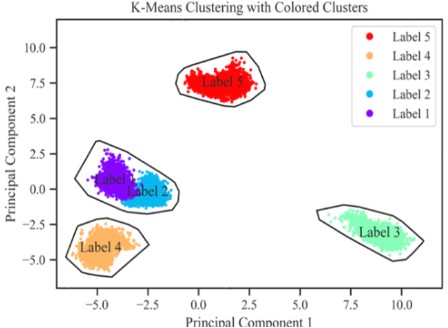
We employed machine learning-based classification to distinguish the conformational states of the α,β-tubulin dimer bound to five different ligands with varying capacities to inhibit microtubule formation.
This approach enabled the identification of ligand-specific conformational signatures and helped discriminate between their underlying mechanisms of action, which are otherwise difficult to resolve using conventional structural analysis.
Biochemistry
Biomolecular Structure and Dynamics
Computational Biology and Chemistry
Proteins.
Biomol Struct Dyn
Biosci Rep.
Int J Biol Macromol
J Chem Inf Model
Biochim Biophys Acta Gen Subj
Sci Rep.
Comput Biol Chem.
RSC Med Chem.
Comput Biol Chem.
Plant Sci.
J Mol Model.
Biochemistry
IUCrJ.
Front Plant Sci.
J Phys Chem B.
Chem Phys Lipids.
Chem Inf Model.
Plant Sci.
Comput Biol Chem.
Chem Inf Model.
PLoS One.
Proteins Struc Func Bioinf
Phys Chem B.
Phys Chem Chem Phys.
Biochemistry
Biol Direct.
Protein J
Mol Graph Model.
Biomol Struct Dyn.
PLoS One
PLoS One
Biochemistry
Cell Cycle
PLoS One
Drug Dev. Res.
Cell Cycle
Ex students who have already been awarded with the doctoral degree:
 Trainee/Interns, etc.
Dr. Debarati Paul (Project Scientist), Megha Ghosh (Senior Research Fellow), Avibrata Dutta (Junior Research Fellow), Payel Bhanja (Junior Research Fellow), Mrs. Munmun Dey (Scientific Administrative Assistant, project funded)
Ph.D. Positions: Our group is looking for at least 2-3 motivated students. Candidates with Masters in Chemistry/ Biophysics/ Biochemistry/ Physics/ Biotechnology/ Statistics/ Computer Applications, etc. and with NET-JRF or equivalent qualification for fellowship may send their CV by email to sgd[at]jcbose.ac.in.
Postdoc/RA positions: Currently we are looking for candidates with knowledge on Machine Learning based data analytics or at least the candidate who have interest to learn these methods to make applications. Anyone willing to apply for N-PDF (SERB)/ DBT-RA or equivalent, may contact by email.
Associate Editor, Frontiers in Molecular Biosciences