Theoretical Physics & Environment Sciences
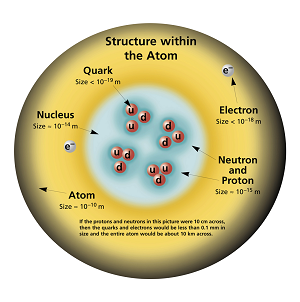
Inside the Atom
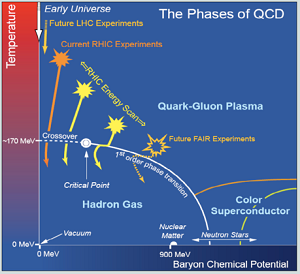
QCD Phase diagram
In this Programme, scientists contribute towards fundamental theoretical knowledge as well as pursue experimental studies, together with exploring possibilities of practical applications. The Thrust areas of current research activities are as follows:
- Thermodynamics of Strongly Interacting Matter and Astrophysics in extreme conditions of Temperature and Density; Properties of Compact Astrophysical objects like Neutron Stars and Quark Stars.
- Cosmological implications of Strong Interaction Physics and Phase Transitions.
- Instrumentation for Experimental High Energy Physics (Detectors and Data Acquisition Systems for ALICE-CERN and CBM-FAIR) and Medical Imaging; Analysis of experimental data to understand the physics of Ultrarelativistic Heavy Ion Collisions.
- Cosmic Ray Astrophysics, Gamma Ray Astronomy, and Computational Fluid Dynamics.
- Nuclear Physics with Rare Isotope Beams.
- Complex systems, Complex Networks, Systems Biology, and Statistical Physics.
- Chemistry and Physics of Atmospheric Pollutants and their role in Climate Change; Interaction between Cosmic Rays and Aerosols in the context of Regional Climate and Cloud Microphysics.
- Experimental Condensed Matter and Radiation Physics, including Physics of Superheated Emulsion Detectors.
- Electronic Structure and Transport Properties of Perovskite Oxides.
- Optical Spectroscopy of Semiconductor Quantum Structures and of Two-dimensional layered materials, and Surface Enhanced Raman Spectroscopy.
- Role of Quantum Entanglement in Quantum Information Theory.
- Quantum Nonlocality, Steerability, Quantum Measurements, and Interplay between Quantum Foundations and Information Theoretic Protocols.
Faculty members associated with this programme
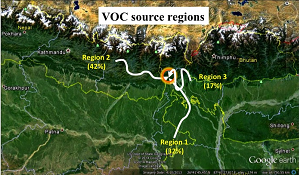
VOC source region
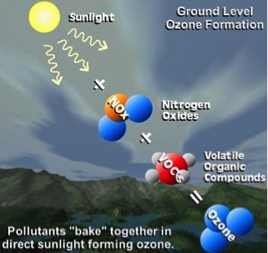
Ozone formation