Differential association of primary and alternative σ factors with RNA polymerase of Mycobacterium tuberculosis during transcription elongation
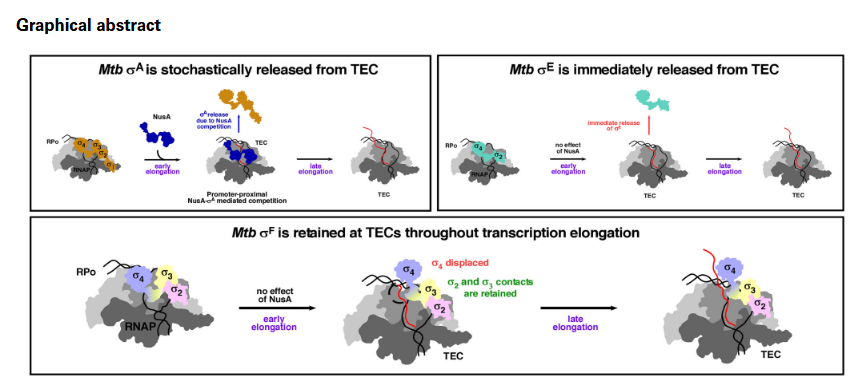
In response to environmental cues, bacteria alter gene expression by switching s factor(s) that recognize a specific set of promoters. This ‘s-cycle’, in which s binds to RNA polymerase (RNAP) to initiate transcription and is released during transcription elongation, is thought to be an essential step for s-switching. Studies in Escherichia coli provide evidence that s70 is stochastically released from the elongation complex. This ‘s-cycle’ became a general model for all s factors of all bacteria. Here, using three distinct groups of s factors in Mycobacterium tuberculosis, we show that although a significant fraction of sA and sE are stochastically or immediately released from RNAP during the transition from transcription initiation to elongation, most of sF are retained. We also show that NusA facilitates sA release from elongation complexes at specific genes but does not affect the release of sE and sF. Our results further indicate that sF remains bound at the elongation complex despite the displacement of s4, as s2 and s3 remain associated with RNAP. Our study demonstrates that s-release is not a universal phenomenon—the release or retention of s factor depends on its domain architecture. Details Link
Nilanjana Hazra, Jayanta Mukhopadhyay, Differential association of primary and alternative s factors with RNA polymerase of Mycobacterium tuberculosis during transcription elongation, Nucleic Acids Research, Volume 54, Issue 1, 13 January 2026, gkaf1459, https://doi.org/10.1093/nar/gkaf1459
Month Year : January - 2026